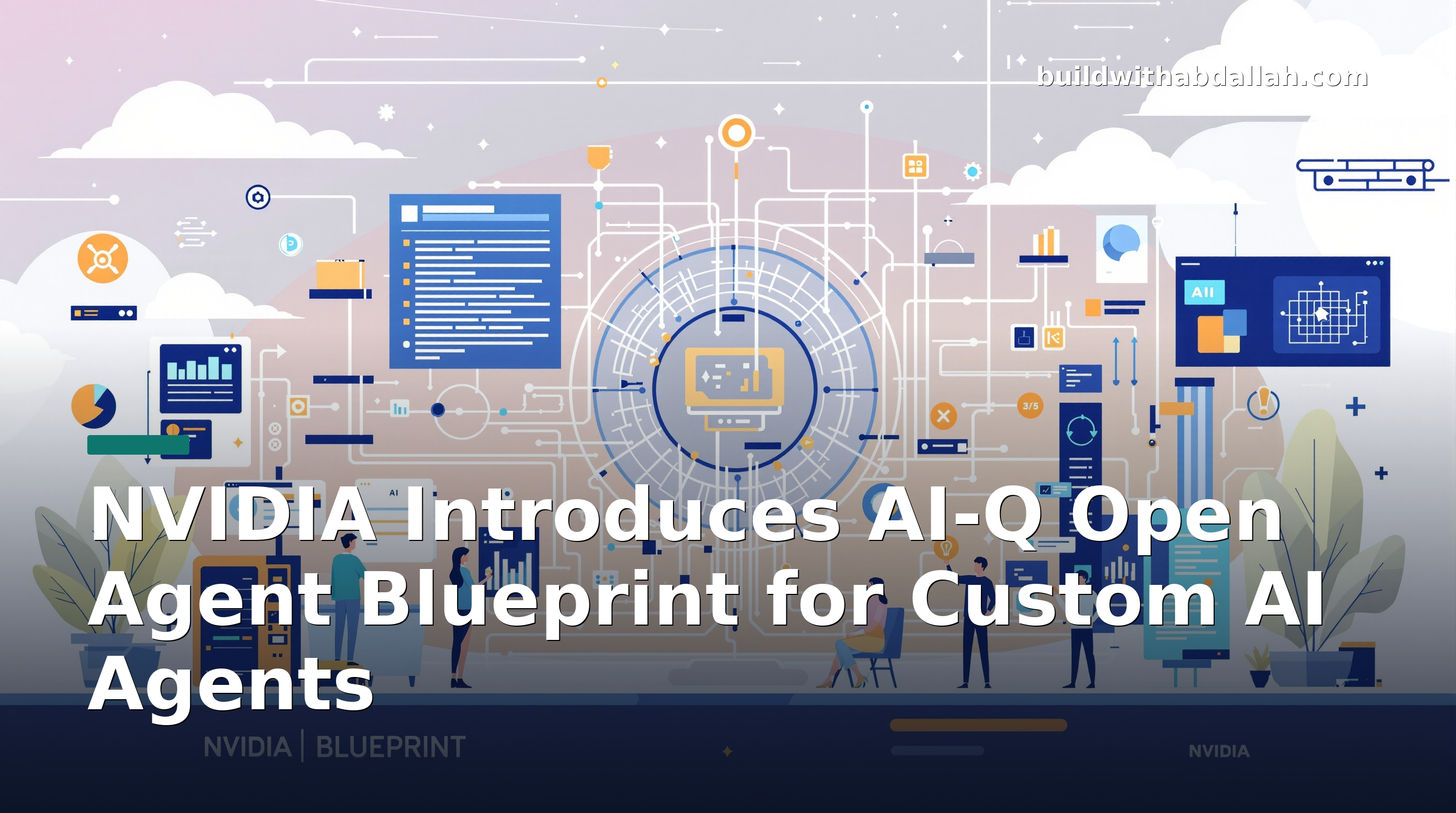
NVIDIA Introduces AI-Q Open Agent Blueprint for Custom AI Agents
What Happened
NVIDIA has unveiled the AI-Q open agent blueprint, a pivotal component of their new Agent Toolkit, designed to empower developers in crafting custom AI agents. These agents are engineered to perceive, reason, and act upon enterprise knowledge, marking a significant leap forward in AI-driven automation and knowledge work. The AI-Q blueprint, built with LangChain, incorporates NVIDIA OpenShell, an open-source runtime that bolsters the safety and security of these autonomous agents. The toolkit also includes open models like NVIDIA Nemotron and open skills such as NVIDIA cuOpt, providing a comprehensive suite for developers.
Why Developers Should Care
The introduction of the AI-Q open agent blueprint represents a major advancement for developers keen on building autonomous AI agents. This toolkit addresses the growing demand for AI solutions capable of handling complex tasks by autonomously determining how to complete them. The AI-Q blueprint empowers developers to create agents that can intelligently select data sources and determine the depth of analysis required, delivering precise and context-aware responses.
For developers working with enterprise software, this toolkit offers a pathway to enhance productivity by deploying specialized agents that can manage and execute tasks without constant human oversight. The inclusion of OpenShell ensures that these agents operate within secure and policy-compliant environments, which is crucial for maintaining data integrity and privacy.
However, developers should be aware of potential drawbacks. The reliance on NVIDIA's ecosystem might limit flexibility for those who prefer other platforms or technologies. Additionally, the learning curve associated with mastering the toolkit's components, such as LangChain and OpenShell, could be steep for some developers.
Real-World Example
Consider a Python developer working in a large corporation that handles vast amounts of customer data. Using the NVIDIA AI-Q blueprint, the developer can create an AI agent that autonomously analyzes customer feedback, identifies trends, and suggests actionable insights to improve product offerings. The agent could use NVIDIA cuOpt to optimize resource allocation for customer service teams, ensuring that the most critical issues are addressed promptly.
For a Laravel developer, integrating an AI agent into an existing web application could streamline backend processes. The agent could automatically manage database queries, optimize server load, and provide real-time analytics to improve user experience. This integration would not only enhance operational efficiency but also allow developers to focus on more strategic tasks, knowing that routine processes are being handled autonomously.
Builder's Take
As an independent developer, I'm intrigued by the potential of NVIDIA's AI-Q blueprint. The ability to create agents that can autonomously handle complex tasks is appealing, especially for projects that require scalability and efficiency. However, I'm cautious about the hype surrounding AI agents. While the toolkit promises significant advancements, it's essential to test its capabilities in real-world scenarios before fully committing to it.
I would start by experimenting with the OpenShell runtime to understand its security features and how they integrate with existing systems. Additionally, exploring the LangChain framework will be crucial to see how it facilitates the development of reasoning and action capabilities in AI agents. This hands-on approach will provide a clearer picture of the toolkit's practical applications and potential limitations.
One limitation I foresee is the dependency on NVIDIA's ecosystem, which might not suit all projects. Developers should evaluate whether the benefits of the AI-Q blueprint outweigh the potential constraints of platform dependency. Moreover, the success of these agents will largely depend on how well they can be integrated into existing workflows and systems, which may require significant customization and adaptation.
Sources
- NVIDIA Ignites the Next Industrial Revolution in Knowledge Work With Open Agent Development Platform
What I'll Be Watching
Moving forward, I'll be keeping an eye on the following developments:
-
Adoption Rates: How quickly will enterprises adopt the AI-Q blueprint, and what industries will lead the charge? The speed and breadth of adoption will be telling indicators of the toolkit's practicality and appeal across different sectors.
-
Integration with Other Platforms: Will NVIDIA's toolkit offer seamless integration with non-NVIDIA technologies, or will it remain a closed ecosystem? The ability to integrate with a wide range of platforms will be crucial for developers who work in diverse technological environments.
-
Performance Benchmarks: As more developers experiment with the AI-Q blueprint, benchmarks on performance and efficiency will be crucial in assessing its real-world impact. These benchmarks will help determine whether the toolkit can deliver on its promises of enhanced productivity and efficiency.
-
Security Enhancements: Updates to OpenShell's security features will be vital in ensuring that autonomous agents operate safely in diverse environments. Given the increasing importance of data security and privacy, any advancements in this area will be closely monitored.
-
Community Feedback and Contributions: The open-source nature of the toolkit means that community feedback and contributions will play a significant role in its evolution. Observing how the developer community engages with the toolkit will provide insights into its strengths and areas for improvement.
These developments will provide valuable insights into the practical applications and limitations of NVIDIA's AI-Q blueprint in the evolving landscape of AI-driven automation. As the industry continues to explore the potential of autonomous agents, the lessons learned from early adopters and community feedback will be instrumental in shaping the future of AI in enterprise environments.