
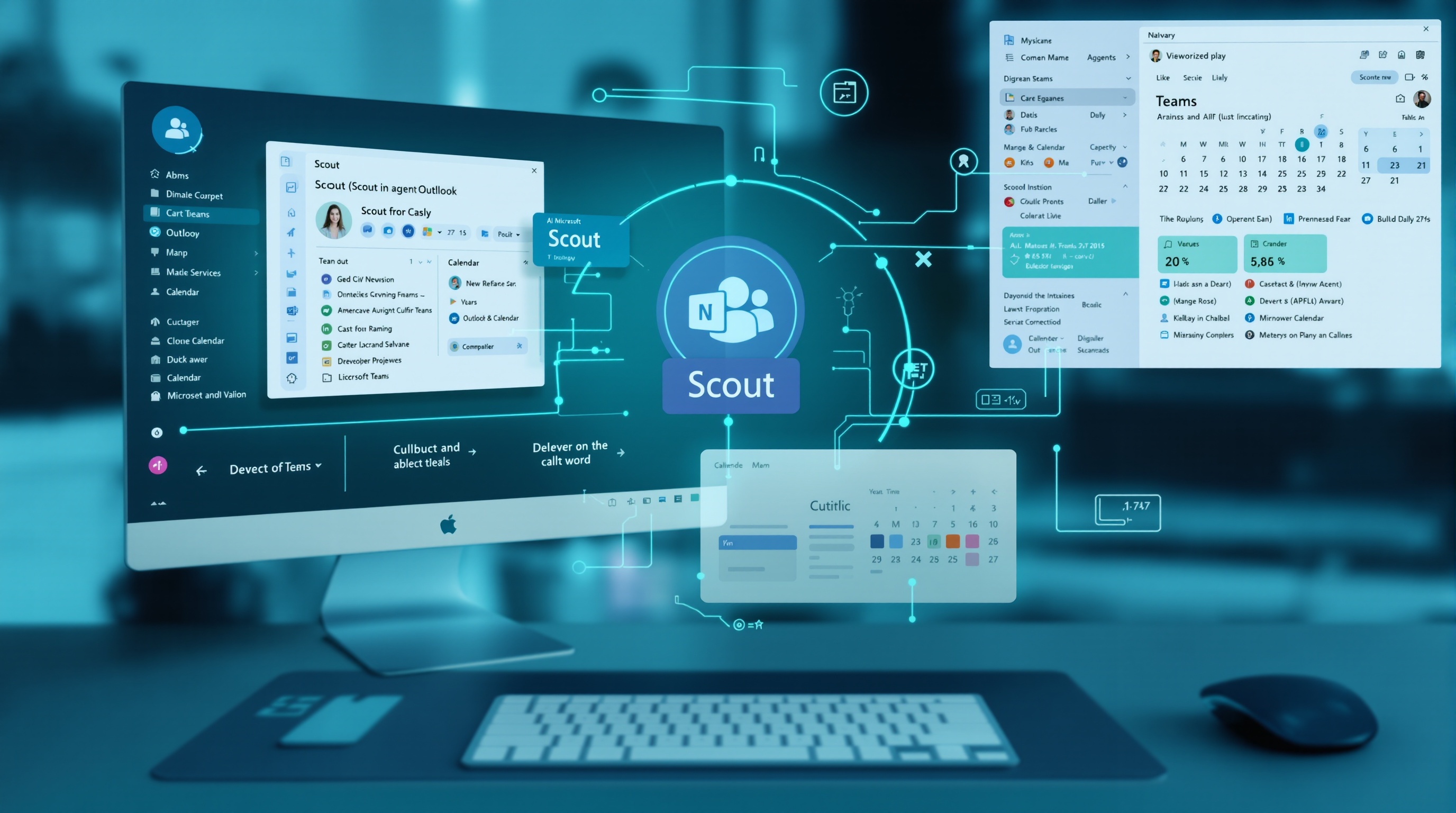
Microsoft Scout at Build 2026: What Developers Should Know About Personal AI Agents
At Microsoft Build 2026 (June 2–3, San Francisco), Satya Nadella opened the keynote with a clear thesis: Windows is no longer a platform for human users only. Agents are now first-class citizens. The biggest proof of that vision is Microsoft Scout — the company's first "Autopilot" agent, and a signal of where AI is heading.
If you're a developer, founder, or tech builder, here's exactly what Scout is, how it works under the hood, and what the broader Build 2026 announcements mean for your stack.
1. What Is Microsoft Scout?
Microsoft Scout is the first in a new category of AI agents Microsoft calls Autopilots: always-on agents that work autonomously, with their own identity, and act on your behalf.
Unlike Copilot—which waits for a prompt and responds—Scout never stops. It has its own persistent identity across Teams, Outlook, OneDrive, and SharePoint. It understands your work patterns, schedules, and priorities, then takes action without being asked each time.
"Scout operates across cloud, desktop, and web, connecting to Teams, Outlook, OneDrive, and SharePoint, and to the data that powers your day, including chats, email, calendar, and contacts." — Omar Shahine, CVP of Microsoft Scout
Key facts:
- Announced: June 2, 2026 at Build 2026
- Availability: Frontier program (early access for Microsoft 365 subscribers)
- Requirements: GitHub Copilot subscription + Microsoft 365
- Platforms: Windows 11+, macOS 12+
- Internal traction: 3,000+ daily active users inside Microsoft before launch
2. Technical Architecture: OpenClaw + WorkIQ + MXC
Scout's architecture is a three-layer stack that developers should understand:
Layer 1: OpenClaw (Agent Framework)
Scout is built on OpenClaw, the open-source platform for local, autonomous AI agents that took the industry by storm in late 2025. (OpenAI later acquired the founder in early 2026.) OpenClaw gives Scout:
- Local agent execution with on-device data access
- Persistent agent memory and identity
- A plugin/skill system for extending capabilities
Microsoft contributed its policy conformance system back upstream to OpenClaw, so the entire ecosystem benefits from enterprise-grade guardrails.
Layer 2: WorkIQ (Context Engine)
WorkIQ is the intelligence layer behind Microsoft 365 Copilot. It captures organizational context — who you communicate with, which documents you edit, what meetings matter, and the relationships between all these signals.
Rather than isolated text prompts, WorkIQ builds a graph of how you actually work. This is what lets Scout understand that a scheduling conflict with a key colleague is more critical than one with a mailing list.
For developers: The WorkIQ APIs become generally available on June 16, 2026 — giving you direct access to this organizational context for your own agent applications.
Layer 3: Microsoft Execution Containers (MXC)
Security is the obvious concern with always-on autonomous agents. Microsoft addresses this with MXC — OS-enforced sandbox environments for agents.
"Agents can execute multi-step workflows locally while running inside an operating system-enforced boundary rather than unmanaged user sessions." — Kyle Daigle, Microsoft Developer CMO
Each Scout action produces an audit trail via the built-in policy conformance system, continuously checking that the agent operates within set guidelines.
3. How Scout Compares to Copilot
| Feature | Copilot | Scout (Autopilot) |
|---|---|---|
| Interaction model | Reactive (prompt → response) | Proactive (always-on) |
| Identity | Stateless session | Persistent agent identity |
| Context | Per-prompt | Continuous (work graph) |
| Actions | User-initiated | Self-initiated |
| Scope | Single app at a time | Cross-app, cross-platform |
The two tools are designed to work side-by-side, not replace each other. Copilot handles explicit queries; Scout handles ongoing coordination.
4. The Broader Build 2026 Developer Ecosystem
Scout is one piece of a much larger platform shift. Here's what else shipped at Build 2026 that developers should care about:
Windows Agent Framework (WAF) v1.0 — MIT Licensed
Microsoft's SDK for building agents across Windows, Windows 365 Cloud PCs, and Azure Arc edge devices. Agents are defined in YAML — not tied to any runtime — and can escalate from local laptop to GPU node without re-architecture.
github.com/microsoft/windows-agent-framework
Windows Agent Runtime (Preview)
OS-level APIs that let agents run as first-class Windows citizens, not just application processes. Initially supports text-based agents on structured data (JSON, XML, PDFs).
Windows Agent Store (Announced)
A curated marketplace for agent manifests. 85% revenue share — matching the Microsoft Store model — with mandatory security reviews.
Project Polaris — Microsoft's Own Coding Model
A mixture-of-experts model that will replace GPT-4 Turbo as the default for GitHub Copilot starting August 2026. Outperforms GPT-4 on HumanEval/MBPP, with particular gains in Rust and Haskell. Runs on custom Maia AI accelerators.
Azure Agent Mesh
A control plane that federates agent execution across on-prem servers, Cloud PCs, and Azure Arc edge. Uses the same local WAF APIs. GA targeted for Q4 2026.
Copilot Workspace GA
GitHub's agentic programming environment graduated from beta, shipping with:
- Fleet mode — autonomous operation on codebase tasks without per-step confirmation
- Autopilot mode — scheduled background maintenance tasks
- Copilot Extensions — Jira, Datadog, ServiceNow integrations
MAI Model Suite v2
Microsoft's multi-model push: MAI-Image-2.5 (editing + generation), MAI-Voice-2 (multilingual, emotional range), and MAI-Transcribe-1.5 (3.9% WER on FLEURS).
5. What This Means for Developers
If you build on Microsoft 365
The WorkIQ APIs (available June 16) give you the same organizational context that powers Scout. You can build agents that understand your users' actual workflows — not just their prompts.
If you build agents for Windows
WAF + Agent Runtime provide an OS-native, MIT-licensed foundation. Your agents can run locally, in the cloud, or across both—with the Agent Store offering a distribution channel at 85% revenue share.
If you're curious about Scout today
Join the Frontier program (accessible to all Microsoft 365 subscribers). Scout is experimental, but it's shipping real code that Microsoft employees are already using daily.
The security baseline
MXC containers and the policy conformance system mean you can build autonomous agents with OS-level sandboxing and full audit trails — addressing the biggest concern about OpenClaw-style agents running wild.
6. Getting Started: First Steps
- Join Frontier — Visit the Microsoft 365 admin center and opt into the Frontier program.
- Name your Scout — Each Scout instance gets a name and identity.
- Explore pre-built skills — Calendar management, meeting agendas, email triage.
- Train your agent — The customization loop is the key differentiator. The more feedback you give, the better Scout adapts.
- Watch the WorkIQ API launch — June 16. This is where the real developer opportunity begins.
Sources
- Microsoft — Introducing Microsoft Scout: Your always-on personal agent
- Thurrott — Build 2026: Microsoft Unveils Scout Personal Work Agent
- TechCrunch — Microsoft launches Scout, an OpenClaw-inspired personal assistant
- Mashable — Microsoft launches new personal AI agent, Microsoft Scout
- ChatForest — Microsoft Build 2026 Recap: Windows Is Now an Agent Platform
- Studio Global — Microsoft Scout at Build 2026: The Always-On Autopilot Agent
Follow for more hands-on engineering content about AI agents, developer tools, and building on the Microsoft stack.