
Laravel quietly shipped one of the most practical AI workflow improvements PHP developers will actually feel day-to-day.
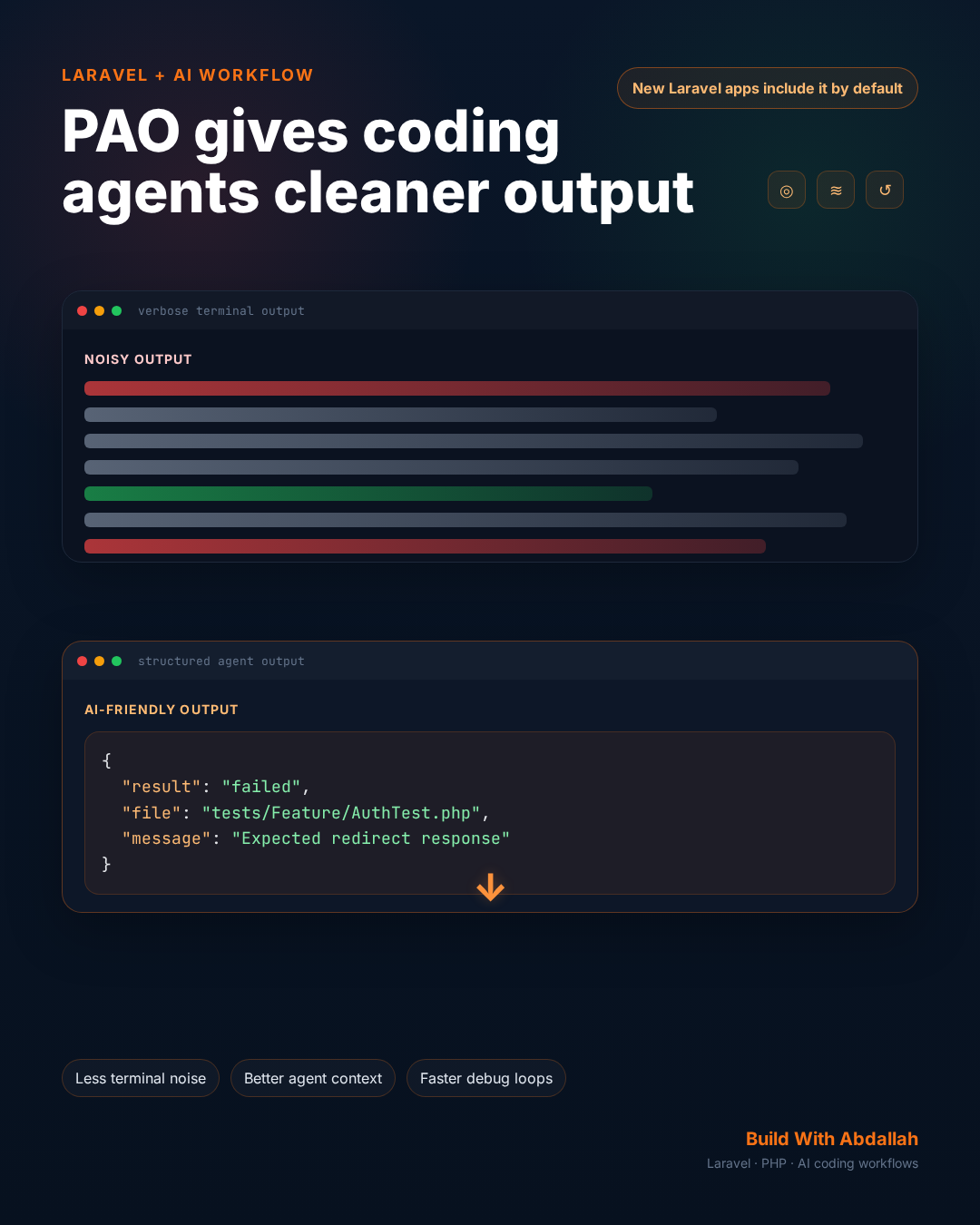
PAO stands for PHP Agent-Optimized Output. It gives coding agents cleaner, structured output from PHPUnit, Pest, Paratest, PHPStan, Rector, and Artisan instead of forcing them to parse noisy terminal logs.
Why this matters
Most AI coding demos focus on model intelligence.
Real day-to-day productivity is often much simpler:
- less junk in the terminal
- cleaner context for the agent
- faster debugging loops
- easier refactors
- fewer wasted tokens on formatting noise
That is exactly what PAO improves.
What Laravel shipped
According to Laravel’s official announcement, PAO:
- detects when PHP tools are running inside an AI agent
- returns compact structured JSON for PHPUnit, Pest, Paratest, PHPStan, and Rector
- strips decoration and excess formatting from Artisan output
- leaves the normal human terminal experience unchanged
- is now included by default as a dev dependency in new Laravel applications
This is a smart move because it improves the workflow without asking developers to learn a new command pattern.
The practical builder angle
This is not about hype.
It is about making agent workflows less annoying.
When an agent can immediately see the failing assertion, file path, line number, PHPStan identifier, or Rector diff, the loop gets tighter:
- run tool
- read clean result
- patch code
- rerun
That means better debug and refactor cycles for real PHP projects.
Why developers should care
If you are using Claude Code, Cursor, Gemini CLI, Devin, or other coding agents on a Laravel or PHP project, this is the kind of improvement that actually compounds.
Cleaner output = better agent context. Better context = fewer dumb retries. Fewer dumb retries = faster progress.
That is the part people actually feel.