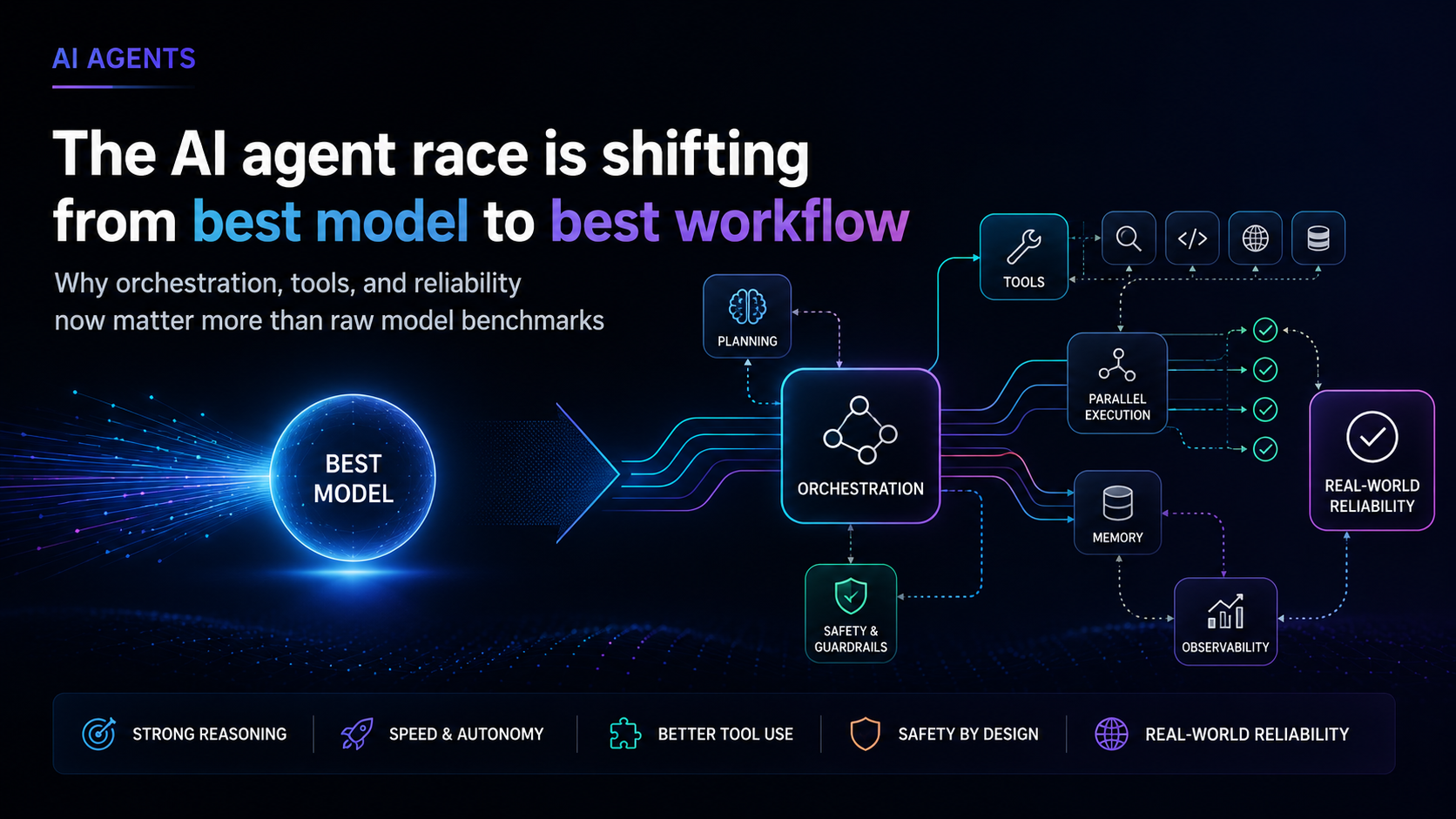
The AI agent race is shifting from best model to best workflow
This week’s AI news points in the same direction.
The biggest players are no longer acting like the main battle is simply “who has the smartest model.” They are building toward a different goal: agents that fit real workflows.
That matters because most teams do not need another flashy demo. They need systems that can plan, call tools, work safely, run in parallel, and stay useful once the novelty wears off.
The signal from Google
At Google I/O 2026, Google introduced Gemini 3.5 as a model family built around “frontier intelligence with action.” The company also pushed Antigravity 2.0 as an agent-first development platform with parallel agents, scheduled tasks, and tighter production tooling.
That is an important shift in framing.
Google is not just selling model quality. It is selling agentic execution: speed, orchestration, and workflows that can move from prompt to production.
The signal from Anthropic
Anthropic’s recent Claude engineering updates are making the same point from another angle.
One post focused on sandboxing in Claude Code to reduce permission prompts while improving safety. Another explained how MCP-based code execution can reduce context overload and make tool-heavy agents more efficient.
That is not just a model story.
It is an infrastructure story. Anthropic is investing in the messy details that make agents usable in serious development environments: isolation, tool access, autonomy, and lower operational friction.
The signal from OpenAI
OpenAI’s recent Codex release notes also show the same pattern.
The updates are not only about raw intelligence. They focus on goals enabled by default, better remote-control behavior, permission-profile improvements, plugin discovery, and stronger extension lifecycle hooks.
In other words, the platform is evolving toward agents that are easier to manage, observe, and trust during real work.
The signal from OpenClaw
OpenClaw’s latest release continues the same trend from the orchestration side.
The release emphasizes performance improvements, realtime control, voice workflows, and meeting-notes capabilities. That is a reminder that orchestration is becoming its own product layer.
A strong model alone is not enough.
If the system around it is slow, brittle, noisy, or hard to control, the user still loses.
What this means for builders
The AI agent race is becoming a workflow race.
The winners will not just be the tools with the best benchmark headline. They will be the ones that combine:
- strong reasoning
- practical speed
- safer autonomy
- better tool use
- workflow orchestration
- real-world reliability
That is the difference between an agent people demo and an agent people actually keep using.
My take
We are moving from chatbot interfaces to workflow systems.
That is where the real market is being built now.
If you are evaluating AI tools for your team, ask a better question than “Which model is smartest?”
Ask:
- Which one fits our workflow?
- Which one is fast enough to stay in the loop?
- Which one is secure enough to trust?
- Which one reduces work instead of creating more supervision?
That is where the real edge is.
Sources
- Google: Gemini 3.5 — frontier intelligence with action
https://blog.google/innovation-and-ai/models-and-research/gemini-models/gemini-3-5/ - Google I/O 2026 developer highlights
https://blog.google/innovation-and-ai/technology/developers-tools/google-io-2026-developer-highlights/ - Anthropic: Beyond permission prompts: making Claude Code more secure and autonomous
https://www.anthropic.com/engineering/claude-code-sandboxing - Anthropic: Code execution with MCP: Building more efficient agents
https://www.anthropic.com/engineering/code-execution-with-mcp - OpenAI Codex releases
https://github.com/openai/codex/releases - OpenClaw releases
https://github.com/openclaw/openclaw/releases